CEAUL · FCUL Workshop

48 Hours of
Estimating Animal Abundance

📅 11–12 June 📍 FCUL, Lisbon
Reserve your seat
0
Days
0
Activities
0
Course seats
Fun

Two days on wildlife abundance

How many are out there? It's one of the oldest questions in ecology — and one of the hardest to answer well. This two-day event brings researchers and students together around the practice of estimating wildlife abundance, with a focus on distance sampling and mark-recapture methods.

A live page — check back for updates. We're still putting the days together but wanted to get the information out as early as possible, so consider this site a work in progress. We'll keep adding programme details, confirmed talks, logistics, and other useful bits over the coming weeks — pop back regularly.
01

Short Course

A full day of teaching on capture-recapture, distance sampling, density surface models, and data integration. MSc, PhD, and ECRs.

02

Estimation Clinic

Bring your dataset, your dilemma, your half-finished analysis. A morning of hands-on consultancy with the team.

We're still planning how to best structure the clinic — feel free to reach out if you have suggestions.

03

Talks & Posters

An open afternoon of student posters, invited talks, and a round-table discussion. Free and open to all.

On posters — these don't need to be as fully fledged as at a "normal" conference. It's perfectly acceptable, and even somewhat desirable, that posters present possible (even quite vague) plans for abundance estimation exercises, with an "Open Questions" section where participants would welcome feedback and advice.

Best student poster competition — there will be a prize for the best student poster!

The four methods

g(x)

Distance Sampling

Walk the line, record what you see, and let the detection function correct for what you missed. Classic and powerful.

N̂ = (M·n)/m

Mark–Recapture

Catch some, mark them, catch again. The overlap between samples reveals the size of the whole population.

Density Surface Models

Where are the animals, and why? GAM-based DSMs paint density across space using environmental covariates.

surveys telemetry acoustic Integrated Estimate More data → tighter intervals

Data Integration

Surveys, telemetry, acoustic detections — combine multiple data streams in a single coherent likelihood for better estimates.

From line transects to detection functions

Distance sampling turns the simple act of walking a line and recording animals into a rigorous estimator of density. The further out an animal sits, the less likely you are to detect it — the detection function captures that decay, and corrects for what you missed.

Mark-recapture takes a different angle: catch some, mark them, catch again, and let the overlap tell you the population size. Over the workshop we'll cover both, plus the modern density-surface and point-process extensions that bring spatial covariates into the picture.

Transect line w w g(x) distance x 1 0 observer

The schedule

8:30 – 9:00
Registration / Onboarding
PA
9:00 – 9:30
Introduction to estimating animal abundance
Tiago A. Marques
9:30 – 10:30
Capture-recapture
Stephane Moura
10:30 – 11:00
Coffee break
11:00 – 12:45
Capture-recapture (practical)
Stephane Moura + all
12:45 – 14:00
Lunch break
14:00 – 14:30
Introduction to Distance Sampling
Tiago A. Marques
14:30 – 15:15
Density Surface Models (DSMs)
Miguel Martins
15:15 – 16:15
GAM-based DSMs in practice
Miguel Martins + all
16:15 – 16:45
Coffee break
16:45 – 17:30
Point process DSMs practice
Moritz Klaassen
17:30 – 18:00
Discussion & closing remarks

Morning — Clinic (target 40 max, MSc / PhD / ECRs, NGOs, Environmental Impact Assessment companies). Afternoon — open to all interested, no caps.

Coming as a group? If you're bringing students or are 3+ people, please get in touch beforehand. If your group is coming to present a case study, a single person from the group can cover the registration. We anticipate that case studies during the clinic will be presented by teams rather than individuals.

9:00 – 12:30
Density / abundance estimation clinic & consultancy
12:30 – 14:00
Lunch break
14:00 – 14:30
Student poster presentations
30 min
14:30 – 14:50
Choosing the right abundance estimation method for cetacean populations
Stephane Moura
14:50 – 15:10
Opportunistic distance sampling for habitat-based Density Surface Models: A common dolphin case study
Miguel Martins
15:10 – 15:30
Integrating systematic surveys and whale-watching data for enhanced spatiotemporal cetacean distribution models
Moritz Klaassen
15:30 – 15:50
Data Fusion for Great Ape Population Monitoring
Andrew Houldcroft
15:50 – 16:10
The past, the present, the future: tools and methods for density estimation
Tiago A. Marques
16:10 – 16:45
Coffee break & posters
16:45 – 17:30
Round-table discussion

The venue

The workshop is hosted at Faculdade de Ciências da Universidade de Lisboa (FCUL), in Building C6, in rooms 6.2.40 and 6.2.53. Coffee breaks and social moments happen at Bar do C6.
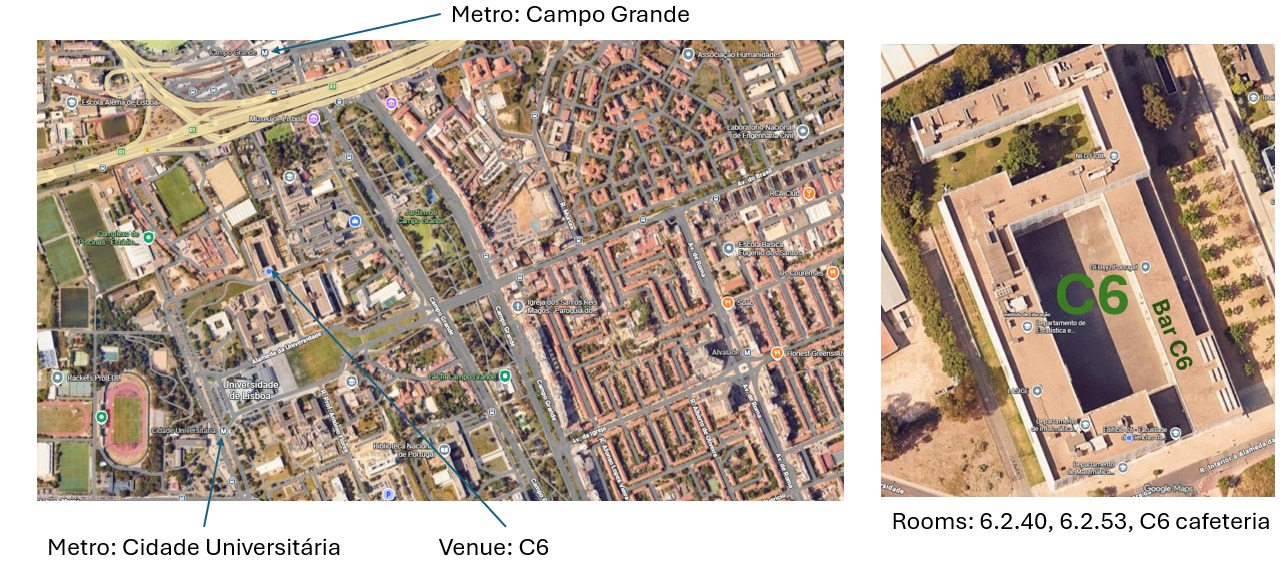
Map showing FCUL Building C6 and nearby metro stations Campo Grande and Cidade Universitária

Click the map to enlarge.

Getting here by metro

Two metro stops are walking distance from the venue:

  • Campo Grande (yellow & green lines)
  • Cidade Universitária (yellow line)

FCUL room numbering

Room codes follow the pattern building.floor.room — e.g. 6.2.40 means building C6, floor 2, room 40.

Choose your attendance

Three complementary activities, designed so you can come for everything or just the parts that matter to your work.

Complete program Day 1 only Day 2 morning only Day 2 afternoon only*
General public 150 100 75 3
FCUL researchers 100 60 50 3
Students (all levels) 75 50 50 3
CEAUL members 50 30 30 3
* About the afternoon fee — we need to know how many people are coming for logistic and preparation reasons. The fee for the Day 2 afternoon is symbolic and is enforced because it has been shown that people are much more likely to attend an activity they have enrolled for if there's a cost to it, even if the cost is residual. We appreciate your understanding.
Can't fund yourself? — If you're desperate to come and can't cover the fee, or you're with an NGO out there saving the world, please reach out. We'll work with you so that lack of funds isn't the reason you miss the event.
Organized by
CEAUL @ FCUL

Your organizers

Tiago A. Marques
Organizer
Read bio →
Stephane Moura
Capture-recapture
Read bio →
Moritz Klaassen
Data integration
Read bio →
Miguel Martins
Density surface models
Read bio →
Pilar Lobo Antunes
Project manager & teaching assistant
Read bio →
Andrew Houldcroft
Spatial point processes
Read bio →
Martim Quinta
Teaching assistant
Read bio →
Eliette Hamard
Teaching assistant
Read bio →
Catarina Fonseca
Teaching assistant
Read bio →

Ready to join us?

Spaces are limited — 30 seats for the short course, 10 teams for the clinic. The afternoon of talks and posters is free and open to everyone.

Register now
Questions? Get in touch with us — 48hour.abundance@gmail.com
In partnership with
Funded by

Funded by national funds through FCT – Fundação para a Ciência e a Tecnologia, I.P., under CEAUL Research Unit, UID/00006/2025, DOI: https://doi.org/10.54499/UID/00006/2025, and by the European Union – NextGenerationEU through the project UID/PRR/00006/2025, DOI: https://doi.org/10.54499/UID/PRR/00006/2025.